geo vs seo in 2026
Search behavior has shifted dramatically. Instead of scrolling through blue links, users increasingly rely on conversational engines like Perplexity, ChatGPT, Gemini, and Google AI Overviews to synthesize information instantly. This evolution introduces a fundamental question: geo vs seo in 2026—which framework should drive your content strategy?
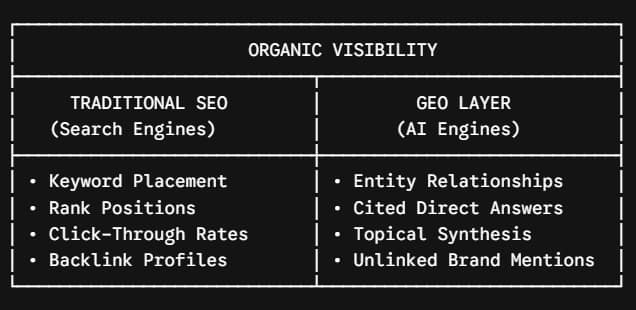
While traditional Search Engine Optimization focuses on ranking web pages, Generative Engine Optimization (GEO) focuses on getting cited, referenced, and summarized inside AI-generated answers. Understanding how these two models interact is essential for preserving online visibility and driving targeted organic growth.

What is GEO in SEO?
To understand the core difference between geo vs seo in 2026, we must first clarify: what is geo in seo?
Generative Engine Optimization (GEO) is the technical and structural practice of optimizing content so that large language models (LLMs) and retrieval-augmented generation (RAG) systems can parse, understand, and cite your brand as an authoritative source.
When asking what is geo in digital marketing, it represents a transition from keyword-centric matching to entity-based understanding. Unlike classic search engines that index pages based on crawl depth and keyword placement, generative search systems evaluate content on factual clarity, original statistics, authoritative citations, and schema markup.
Disambiguating “GEO”: Targeting and Fencing
In broader strategy, marketers frequently ask what is geo targeting in online advertising or what is geo fencing and how can it benefit local businesses?
- GEO (Generative Engine Optimization): Optimizing content for AI answer generation.
- Geo-Targeting: Delivering advertising content based on a user’s specific geographic location (city, zip code, or country).
- Geo-Fencing: A location-based service that uses GPS or RFID to trigger a virtual boundary, allowing local businesses to send targeted push notifications or ads to mobile devices entering a physical storefront area.
- What is geo in digital marketing? Depending on context, it refers to location-based marketing (targeting/fencing) or generative engine optimization.

Is SEO Dead Now With AI?
A common question among business owners is: why is seo outdated or is seo ded now with ai?
The short answer is no—seo still worth it in 2026. SEO is not dead; rather, the traditional approach to SEO is evolving. AI answer systems rely on web indexes built using classic web crawling, indexation, and technical site health. Without clean technical SEO, structured data, and high-performing web architecture, generative systems cannot discover or verify your site’s information.
Is GEO Going to Replace SEO?
When weighing is geo going to replace seo, it helps to view them as complementary layers rather than direct competitors.
- SEO builds the foundational indexing, crawlability, domain trust, and traditional page rankings.
- GEO optimizes that authoritative content to ensure LLMs extract and mention your brand within summarized responses.
Key Comparisons: GEO vs SEO in 2026
When evaluating which is bettwer seo/geo, the answer depends on user intent. Navigational and transactional queries still rely heavily on traditional search pages, whereas informational research queries rely heavily on generative engine summaries.

How to Optimize Content for GEO and AI Voice Search
Modern voice search tools and LLMs process natural language questions. To capture AI visibility, answer specific queries directly within your content structure.
[User Prompt/Voice Query]
│
▼
[Generative Search Engine]
│
├──────► Parses Entities & Structured Data
├──────► Scans Authoritative Citations & Statistics
└──────► Extracts Direct Answer
│
▼
[Generated Answer + Citation Link]
1. Answer Conversational Voice Prompts Directly
Users utilizing voice search ask complex questions. Structure your content with headings that mirror real-world prompts, such as: “what is GEO and how is it used in digital marketing?” Follow the heading immediately with a concise, direct answer before expanding into details.
2. Incorporate Original Research and Data
AI models favor sources that provide primary data, expert quotes, and verifiable statistics. Articles containing original data points receive significantly higher citation rates in generated answers compared to rehashed information.
3. Implement Comprehensive Entity Schema
Leverage JSON-LD structured data (including Article, Organization, and FAQPage schema) to explicitly define entity relationships. Schema makes it easier for machine crawlers to interpret who you are, what you offer, and why your content is authoritative.
Frequently Asked Questions
Is AI SEO called GEO?
Yes. Is ai seo called geo? Generative Engine Optimization (GEO) is the industry term for optimizing content specifically for generative AI platforms like Google AI Overviews, Perplexity, ChatGPT, and Gemini.
Why is SEO worth it in 2026?
SEO still worth it in 2026 because generative search models source their citations from indexable, technically sound websites with strong baseline authority. Without a solid SEO foundation, your content cannot achieve GEO citations.
Which is better: SEO or GEO?
Neither is inherently better; they serve complementary roles. SEO drives discoverability across conventional engines, while GEO ensures your brand is recommended inside generative AI summaries.
Final Strategy: Integrating GEO vs SEO in 2026
Winning in modern search requires combining traditional technical SEO with GEO tactics. Maintain your site’s crawlability, build domain authority, and implement schema markup. Concurrently, structure your content to answer natural language prompts with data, tables, and clear explanations. This dual approach ensures search engines index your pages and generative models cite your brand.
Conclusion
Navigating the shift between GEO vs SEO in 2026 isn’t about choosing one strategy over the other—it’s about mastering how they work together. While traditional SEO continues to build the technical foundation, crawlability, and baseline domain authority your site needs, Generative Engine Optimization ensures your brand is recognized, summarized, and cited directly inside AI-generated answers.
By combining clean technical architecture with structured entity data, direct answer formatting, and original research, you position your content to capture both classic SERP traffic and generative search visibility. Embracing this dual approach today will keep your brand discoverable, authoritative, and future-proof as search technology continues to evolve.